I get the appeal of small phones, but sheesh, you guys don’t have a lot of options.
I must say that there are wayyyy too many upstarts with closed-source software and hardware. We should fund the likes of Framework, Fairphone, and Librem, and be done with it.
Who knows, fund them enough, and Fairphone/Librem will start making small phones as well. Framework could start making phones, but I digress.
I am not subscribing to read this
The Enough Phone is made by and for people fed up with big screens
Nov 6, 2026 at 7:00 AM EST
It’s a bad time and maybe also a great time to make a new smartphone.
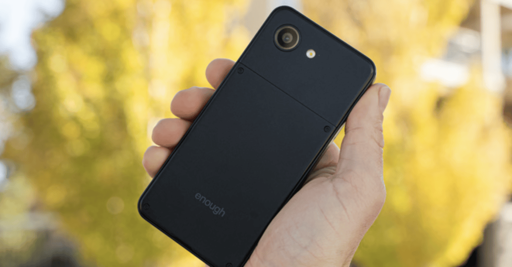
Brennan Jordan and Austin Boer are two-thirds of the trio behind the Enough Phone, a small phone that will run your choice of stock Android or the minimalist OdysseyOS. They’re currently seeking funding on Kickstarter, and just a day after launching, the project is over halfway to its $250,000 goal.
The Enough Phone’s target specifications include a 5.3-inch display, 3,500mAh user-replaceable battery, MediaTek Dimensity 7500 chipset, a 50-megapixel Sony sensor in the rear camera, and 8GB of RAM. The dimensions listed on the Kickstarter page suggest an iPhone Mini-ish size; Jordan and Boer also happen to be former iPhone Mini users themselves.

This prototype unit shows the user-removable back plate that will allow for simple battery swaps.
Photo: Enough Phone
The two of them cofounded a software startup called Sleke, which sells refurbished phones loaded with OdysseyOS, their minimalist, low-distraction version of Android. Putting the software on existing phones is a win for sustainability, but it also helps them get their software to market faster, Boer tells me. The pair offers small batches of Pixel 8 and 9 phones right now through the Sleke website, but the large devices didn’t feel quite right to some customers.
“One of the biggest things that we get is, ‘I don’t want this large of a phone for a minimal operating system,’” says Boer. They’d wanted to make a small phone, and the opportunity arrived when Will Stults approached them about creating one. Stults operates an online store for non-smartphones called Dumbwireless. He also brings familiarity with the smartphone manufacturing process to the mix thanks to some previous work with a “big” phone brand.
But hardware is hard in the best of times, and 2026 has proven extremely challenging for phone companies big and small. The chip shortage has driven prices up and made RAM scarce. Jordan and Boer are feeling the pressures, particularly around pricing. The Kickstarter campaign offers some discounts for early backers, but after that the Enough Phone will sell for $599. “We don’t want to be charging as much as we are,” says Boer, “but as a startup you can only do so much.” They’re a self-funded operation and want to keep it that way, he says, so they can choose their own priorities. Outside funding would change the dynamic and might put pressure on them to shorten their promised five years of software support or cut other costs.
As it stands, the project is on schedule. According to the Kickstarter page, it’s in the production tooling phase, with plans to ship phones to customers in May 2027 — though a footnote says that the RAM shortage’s “ripple effects across the entire electronics manufacturing industry” could still throw a wrench in the works.
Prospects for small phone fans (disclosure: I am one) were bleak even before the chip crisis. Apple’s last Mini was released five years ago, and there’s no indication of another one in sight. Asus’ Zenfone used to be a nice, small-ish Android option before the company made it bigger and quit selling it in the US. Pebble founder Eric Migicovsky made a lot of noise about launching a small phone, but has since shifted priorities. And there’s Unihertz’s Jelly Max — certainly small, but its specs lag behind a modern midrange phone.
Boer sees this gap as an opportunity, even in the midst of a global RAM crisis. “Nobody was doing it, and we’re kind of seeing why — because it’s not the ideal time to start. But that also kind of makes it the ideal time to start, because no one else is doing it,” he says. “Let’s just do it ourselves.” Enough is enough. At least that’s what they’re hoping.
I’m really surprised by the lack of open-source OS choices.
I’m just going to keep buying refurbished iPhone SEs until that becomes impractical. Then I’ll see what the market is like.
How often do you need to replace your phone?
I replaced my Samsung S4 when the UK dropped 3G. My second-hand S10+ is still perfectly fine.
Every time I see the next “phone for people who dislike modern phones” concept they never address my problem. A phone should not cost more than $100.
For that kinda money, you should get yourself a flip phone. They still exist. ;)
A phone that actually costs less than $100 will make money from something other than its purchase price.
In some markets, that means the carrier subsidizing the phone and charging you a high monthly rate. I would counter that phone service should not cost more than $15/month.
The other thing it might do is preload adware, spyware, or outright malware.
I’m willing to pay upwards of £300 max, but it should also include being able to have a SIM card AND an SD card, as well as a headphone jack.
I just want a modern Motorola RAZR, and I don’t mean the current RAZR. Ideally I’d want a 1:1 recreation of the V3xx with modern components and 5G and so on. Like the Light Flip I guess but not as chunky.
And yes, I’ve seen the Vortex V3 and it kinda sucks.
I was in high school when razrs came out and I never had one, but they were pretty popular in my school. I don’t know if it was just the comparison with Nokias, or that all the razr owners I knew were children, but they broke constantly.
Were they better than I remember if you treated them well?
Were they better than I remember if you treated them well?
I briefly had a V3i in like 2010. Never knew anyone who also had one.
Did yours ever break?
I’ve never really had a phone break unreasonably- I went from Nokias to super old iPhones and even though I drop them on tile, concrete, and cobblestones pretty frequently, I just get good cases and I’ve been pretty lucky. Sometimes the screens crack, but I’ve had to replace them more due to storage than anything else (I had 8, 16, and 32 gig models that just don’t work with modern OSs and apps anymore, but I did also run one over with a car, and that reasonably made it mostly unusable).
No, I don’t think what happened to it though.
This
Wow nice idea, but $600 is kinda a bit much. I’ve never paid more than $80.
You either talk about used phones, or you do not understand the concept of a telecom provider’s business model.