i just got back from a week in bali. we rent a mini ev 2 person car to get around and in the span for the whole trip we literally spend $0 because we charge them off the wall plug of the villa we stay at
but if we want to be pedantic the car is Wuling airev and iirc it has 17 kwh of battery. that is quite enough for us for the whole week, we only need to charge it once at 60%. so lets say its around 7 kwh. in Indonesia a kwh cost around $0.1. so for a whole week it only need less than a dollar for ‘gas’
This seemed intuitively wrong to me (like, way too low a cost), but: 25,000 pounds moving 100 mph is equal to 11,331,007 J of kinetic energy. Since 3.6 million J equals 1 kWh and 1 kWh on average costs $0.17, that means you could accelerate 25,000 pounds to reasonable bare minimum flying speed for about fifty cents (not considering efficiency of the machinery). My mind still can’t process this, but math is math.
On the other hand, looking at it from a potential energy perspective it’s a bit more expensive. 25,000 pounds at a cruising altitude of 10,000 ft. (still quite low from an airliner perspective) is about 339 million J, 94 kWh or about $16 – the cost of lunch at MacDonald’s.
Since a plane requires the most thrust at takeoff, you could use ground-based catapults to get the plane to takeoff speed (or faster even) and then you could carry smaller batteries and propelling machinery. For extra fun, you could have landing planes snag a wire and use their momentum to accelerate a plane taking off.
To save even more weight, since you’re going airport-to-airport you could leave off the landing gear and just have the planes come down on a bouncy trampoline-like surface. If you think that’s batshit crazy, the British actually experimented with this idea for their aircraft carriers in the 1950s.
Edit: to make these numbers more realistic I’m going to assume something like a 737, which can weigh something like 150,000 pounds fully loaded (this includes fuel but you’d need batteries instead for an electric plane). Getting this to a 150 mph takeoff speed would take about 100 million J (getting it then to a cruising speed of 500 mph would be another 233 million J, but that’s pretty minor compared to the other costs). Climbing this plane to 30,000 ft would take 6.1 billion J. Resisting a drag force of 5000 pounds (about what a 737 experiences at cruising speed at 30,000 ft) for 500 miles (the distance from Cleveland to New York City) would need 17.6 billion J. Assuming landing is free (fuck TANSTAAFL) that means a typical trip needs 23.8 billion J or 6618 kWh or $1125. Assuming a real-world efficiency of 25% means the actual cost would be $4500 (which is in the ballpark of what jet fuel costs). Assuming 200 passengers, that’s $22.50 per person. Not exactly “$5 of electricity” but surprisingly small.
Feel free to check my math, my brain hurts.
Since a plane requires the most thrust at takeoff, you could use ground-based catapults to get the plane to takeoff speed (or faster even) and then you could carry smaller batteries and propelling machinery.
Don’t you dare talk about catapulting using electric technologies in America though. Steam only! 🇺🇸🗽🦅🏈
I didn’t say which type of catapult. I don’t need ICE showing up at my door.
One important caveat to this. It costs less than 17 cents to generate 1 kwh. Closer to 3 cents really. But that’s the cost of making the electricity, getting that electricity to a house or charger or what have you costs more. Since energy is a for profit industry they tack all the logistics costs to the client buying the electricity.
So your math is spot on but I fear the amount of markup on the electricity will be massive especially since it’s for a business let alone an airline.
National average it’s 55¢ to run 3kw on 3phase electricity for an hour. Offshore areas like Hawaii and Alaska see higher costs like 1.60$/hr per 3kw on 3phase electricity but Alaska has a higher natural gas usage and Hawaii is further away from the CONUS electrical grid. National average per 24/hrs of charging is a little over 13$ with 3kw at 3phase.
And yet it still costs me 30 dollars to charge my car in Georgia and in a state like new York it’s 60 to 100 dollars.
I fucking hate everyone and would love to subject you fucks to 4g of pain taking off with a stupid catapult system. Nice math.
All those screaming kids would get a quick education on how relatively nice everything was before the plane was launched.
“Billy, why are you crying? Do I have to take you on another plane ride? Oh, you’re gonna cry harder now? That’s it, I’m getting the vomit bags. I got this nice new child design one for you that wraps around your head and ties closed at your neck. Won’t that be a treat?”
This plane can’t carry passengers. All the useful load is taxen up by batteries. It’s the fundamental issue with all-electric aviation
Well, feel free to correct me on my math here, I’m no battery expert. Google says a 100 kWh battery typically weighs between 1000 and 1500 pounds. Since we’d need 6618 kWh for the hypothetical trip from Cleveland to NYC, that means we’d need 67 x 100 kWh batteries which would weigh between 67,000 and 100,000 pounds. Google also says the typical fuel load for a 737 is around 50,000 pounds, so the relative overage from batteries (since obviously you wouldn’t need to carry any fuel) would be 17,000 to 50,000 pounds. This would roughly give you a passenger capacity range between 120 and nobody. Even worse if you consider the need to have some reserves of power for unexpected circumstances. There’s also the problem mentioned elsewhere in this thread that the batteries don’t become lighter as they’re discharged, so your landing weight is the same as your takeoff weight.
So yeah, battery weight is the core problem. But if battery weight comes down by “just” 50% (and I have no idea if that’s on the horizon or not) then electric aviation becomes quite viable.
For extra fun, you could have landing planes snag a wire and use their momentum to accelerate a plane taking off.
What about Flintstones style breaks, where everyone’s legs stick out under the plane and they need to use them to stop?
Sure, it wouldn’t be effective, but one or two of these new flights being on the news and global emissions would be down even farther than with your plan.
I was about to crunch the numbers to check for myself, thanks for doing it, you did a great job.
Amazes me how they made it work considering the amount of arcane shit it takes to make jet engines work. Of course it is possible since electric motors are torque monsters, but it still must’ve taken insane efforts to make it work.
I wonder if we’ll see these flying anytime soon or if they’ll get shot down by the fossil fuel i industry just like everything else that is amazing
Wouldn’t work Militarized though because you wouldn’t be able to refuel it mid flight.
Microwave beams from satellites. What could go wrong?
In other words the Us won’t use this technology because it hurts the oil companies pockets
Us??
I’m guessing autocorrect swapped “US” with “Us.”
Wow dang. For some reason I was hoping it was a new slag on the uneducated or something like that.
Damn Us are at our again. Someone should stop the US.
Time to pass those savings onto the
consumershareholders!Every time I hear of an all electric aircraft of any size, I always wonder what they’re going to do about landing weight.
Every modern transport category jet has a higher takeoff weight than landing weight, because of the simple unavoidable fact that landings are rougher than takeoffs. Taking off, the load gradually comes off of the landing gear, on landing it’s suddenly applied. Jets burn tons, literally tons, of fuel enroute, so they’re considerably lighter on approach. It’s why aircraft have dump valves to jettison fuel overboard in case of forced landing early in the flight.
Batteries don’t get lighter as they’re discharged, so…?
You can rethink the engineering with electric motors.
The planes you are describing are designed assuming they will be lighter on landing because of fuel. So why design them for take off weight?
Electric motors are condusive of blown wing design for example, and would have a unique landing profile. (The plane can land at much slower velocity)
Edit: yeah they’ve moved the engine shroud which allows for lower speeds. Given the same runway you would be able to trim vertical speed.
That ain’t gonna happen on a civilian airliner.
Blown wings are basically powered lift. You’re planning on bringing a civilian passenger plane down final approach at a speed it can’t glide at if the power plant fails?
I could see that for a carrier based aircraft where STOL is a factor but no you’re not doing that in airline operations.
Why couldn’t it actually be safer since you could have distributed power centers, across multiple motors?
You could also have hybrid approaches - there is space between not being able to glide and smashing your landing.
I’m just getting at it being a different system so some old assumptions can be reexamined.
Bigger challenge than landing is energy density.
Regardless it’s a very interesting space.
Multiple redundant motors are heavy.
Batteries are far heavier. There’s going to be as many motors are there are propellers, it really doesn’t make sense to do otherwise.
You can rethink the engineering with electric motors.
One of the other limitations is that you’re stuck with propellers if you’re using electric motors, so your top speed is going to be significantly slower than jets. Unless you do the Tu-95 thing with contra-rotating props whose tips exceed the speed of sound, and then you have monstrous noise problems.
Fun fact, batteries DO become lighter when they discharge. But obviously not like fuel. But it’s still a fun fact.
You mean because of e=mc²? That’s true but basically unmeasurable. Air batteries do get mesurable heavier.
If they can fly a small airliner for 30 minutes for $5. Either there’s a whole lot they’re leaving out. or they’re not paying anywhere near what I pay for electricity.
They say the engines delivered more than 1 megawatt of power. Cool, so 1 MW over 30 minutes. That’s 500kWh. Which means if they paid $5 for it. They paid 1 cent per kWh. Now i don’t know about you guys. But i sure as hell don’t pay 1 cent per kWh.
they’re also dont specify how many kwh they used. which is why i assumed a sustained 1mw of power. they also dont say how much the plane weighted. only what it could potentially carry. that doesn’t mean that’s what it weighted in the test.
don’t get me wrong. cool stuff to fly electric planes. but i can’t help but feel incredibly sceptic when they leave out a lot of numbers while making the insane claim that they only used $5 worth of electricity.
I did my best to find any technical data about the flight. Couldn’t find any actual numbers. FWIW it’s not intended to be a standalone method of powering the aircraft for commercial use; they plan on making it a hybrid, which makes far more sense as far as range and payload are concerned. Best guess a 25000 lb aircraft like this will probably cruise around 120-150Kt at a nice, slow, efficient airspeed for a test like this. So maybe a 40-50 mile flight because “air time” probably started as soon as they lifted off.
Yeah the problem is they also don’t tell us the load during the flight. From the lift equation (let’s be hand wavey) if they’re a similar size to a regional jet (same planform area) your heavy lift is better driven by speed than lifting coefficient. Of course, it’s hard to go fast with electric props, so I wonder if a safe ceiling is probably
400Kt300Kt?Gives a nice range of you know… 40 to
200150 miles.Edit:
No way. The speed record for a prop aircraft currently stands at about 300Kt. If we use that generously our new ceiling is lower.
It’s right there, friend.
25,000lb. Reading the article it says “more than 25,000 lb”.
We should assume they used a highly efficient airfoil that can maintain the most efficient possible cruise for the demonstration aircraft probably at L/D max if they’e looking for time aloft, so I doubt it’s even worth considering top speed or ceiling. It would be interesting to know what NACA profile they used and what the top speed characteristics would be.
Edit: looks like a Vne of 140 Kias. This is not a fast aircraft. Also a minimal useful load. If you make a couple clicks through to the site of the test it’ll give you more info.
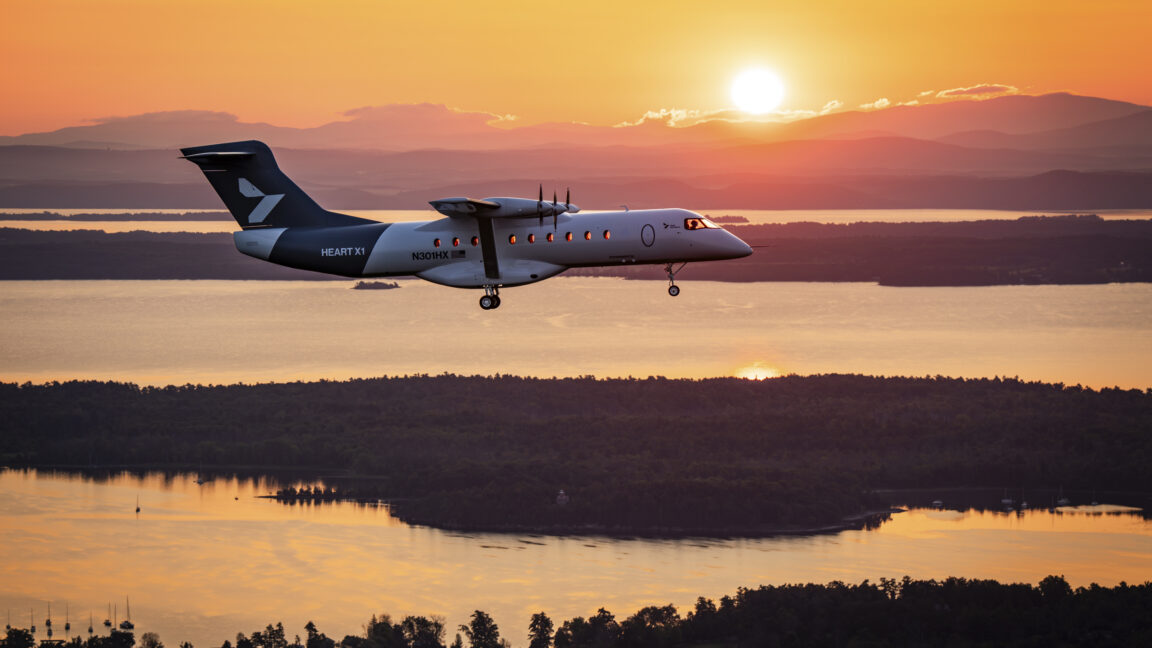
The first flight of the largest battery-electric aircraft to take to the skies lasted nearly half an hour while costing just $5 of electricity.
The X1 aircraft is comparable in size to a small regional airliner and can achieve a maximum takeoff weight exceeding 25,000 pounds with the help of four wing-mounted electric motors. The battery-electric propulsion system delivered more than one megawatt of power during the maiden flight.
It doesn’t tell us what the load was for the test flight at this price point.
You’re probably right that it is good and slow and much less weight.
Likely a short flight.
Oh boy… So, they took off from a test facility adjacent to Plattsburgh International Airport. I don’t see it stated, but I give it 98% they landed where they took off. Plattsburgh has some of the lowest residential and commercial electricity costs in the country, so that $5 nets them about 110kWh of juice.
They also reached a maximum altitude of 1,100 feet with a plane that weighs in excess of 25,000 pounds. Lifting 25,000 pounds up to 1,100 feet takes 37 million joules of added potential energy, or a bit above 10 kWh.
The entire remaining 100kWh of energy budget is the equivalent of accelerating the 25,000 pound aircraft up to 252 meters/second at perfect efficiency in a vacuum. This flight was not going very high, and it was not going very fast.
If the economics of their hybrid idea work out, it’ll be fantastic, but the attempt at marketing over transparency here doesn’t fill me with optimism.
Thank you for that.
They didnt say the planes weighted 25000 pounds. They said it could exceed 25000 pounds. My guess is that not even the passenger seats were installed in this run.
1mw of power from the 4 engines. For 30 minutes, 500kWh. So for $5 they paid 1 cent per kWh. Somewhere there’s a bunch of bullshit hidden.
I give it 98% they landed where they took off
They did. It can bee seen in the press release photos and the video they released
so that $5 nets them about 110kWh of juice
They would have needed more than that. Likely got some lower rate somehow
This flight was not going very high, and it was not going very fast
Vne, max airspeed, of this plane is 140 knots (72 m/s). Less than a Cessna 150. Max altitude is 2,000 feet AGL, significantly lower than a Cessna 150
If the economics of their hybrid idea work out, it’ll be fantastic
It would be, but I highly doubt it. Energy density of batteries is simply too low. This plane can barely fly at slow speeds with no cargo or passengers, and with a cockpit stripped down to a single pilot. Hybrid thrust would be heavier than either jet A or battery-electric, and it still has the downsides of including batteries for the entire flight
Hydrogen or nuclear will be viable before battery-electric in aviation
Good and as battery technology improves, EV aircraft would be ideal for short commuter hops.
Dude, I’d take short hop flights all the time if they end up being that environmentally friendly.
I can understand a hybrid train because of certain sections of track electrification issues and the fact that diesel electric is how even trains that run entirely on diesel operate so you’re essentially just toting around a generator to operate your already electric engine. I understand hybrid cars with regenerative braking and range extension. I don’t really understand hybrid planes.
Like I can imagine electric is more efficient for takeoff because electric engines produce more initial power generally than what fossil can match per engine size(a big part of both hybrid trains and cars both using batteries for initial acceleration) and then you cruise with jet fuel. I’m just having a hard time imagining it is worth it from a defossil fuel perspective or from a straight efficiency perspective.
I really hope this will catch on for once, it could be a great solution for all those people who insist they have to do domestic flights… (in countries like Germany which aren’t that big comparatively speaking)